
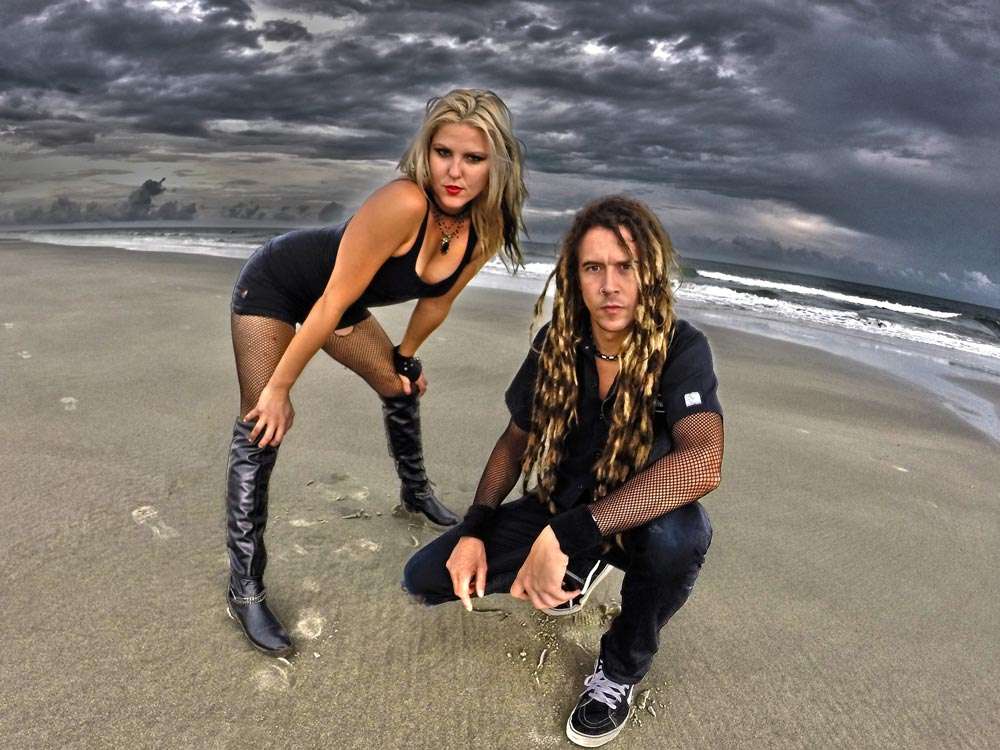
KRASHKARMA have never operated within the expected limits of a two-piece. Their sound is confrontational without being reckless, controlled without losing impact — a balance that becomes especially sharp on Falling to Pieces, a record shaped by tension, uncertainty, and emotional pressure.
Written during a period when the world felt increasingly fractured, Falling to Pieces reflects the strain of isolation, loss, and widening division. Rather than distancing themselves from that weight, KRASHKARMA lean into it, translating unease and personal reckoning into songs that feel deliberate, physical, and lived-in. The aggression carries purpose; the chaos has structure.
In this DeadNote Sessions conversation, KRASHKARMA discuss responding to global unrest through songwriting, the discipline required to let a song go, and why creating moments on stage has become just as important as the music itself.
DeadNoteMedia: When you began writing this record, were you consciously responding to the state of the world at the time?
KRASHKARMA:
“Absolutely. When we write a song we pour our emotions into it. We write about things that concern us and try to make sense of them. During the pandemic, there was a lot to process, and many facets of the uglier sides of humanity were revealed. Friendships fell apart, people died, and the divide between people grew faster than you could say ‘what the fuck.’”
DeadNoteMedia: What proved to be the most difficult part of the recording process for you?
KRASHKARMA:
“The biggest challenge is always finishing a song. Letting it go can be hard when your vision constantly changes and evolves. We write many songs, and only the best ones make it onto the album. Sometimes you have to kill your darlings and sacrifice something for the greater good.”
DeadNoteMedia: “Orphans in Zombieland” pulls directly from classic horror imagery. Of all the living-dead films, which one resonates most with you—and where do you think survival actually exists in that world?
KRASHKARMA:
Dawn of the Dead is probably our favorite. The exploding head scene is unforgettable, and the music and underlying message about consumer society are still so fitting. As for hiding places—none of them. Every hideout eventually becomes a death trap. Run for your life. That said, “Orphans in Zombieland” is actually about racism. It’s the disease we fight every day. When Night of the Living Dead came out in 1968, casting a Black actor as the main hero was also a powerful social statement.
DeadNoteMedia: You’ve described the record’s sound as “Big, Loud, and Exciting.” Was it difficult to balance those elements without losing control of the songs?
KRASHKARMA:
“Creating a record that captures the essence of ‘Big, Loud, and Exciting’ was a thrilling journey. We understand the raw power and energy that fuels our music. Striking the right balance became a deeply personal pursuit—blending precision with unfiltered passion to create something that authentically represents who we are.”
DeadNoteMedia: Vocally, there are some striking moments across the album—particularly on “Afterlife,” “Last Rites,” and “hOPELESS.” When writing, do you map out vocal roles early, or does that develop through experimentation?
KRASHKARMA:
“We usually have a rough idea in the beginning to get the song started, but there’s also a lot of trial and error. Many times we switch parts around and try out every possible scenario until it feels perfect.”
DeadNoteMedia: “How God Lost Her Virginity” moves from vulnerability to force. Did that performance take shape organically, or was it guided toward that emotional arc?
KRASHKARMA:
“It developed organically. To sing a song like this, you have to dig deep into your emotions. Only when you feel absolutely safe in your environment can you deliver a performance that gives you goosebumps. Fortunately, we have our own studio and can create a vibe that allows us to explore freely.”
DeadNoteMedia: “Voodoo Devil Drums” feels purpose-built for the stage. Did that song originate from a desire to spotlight rhythm and dynamics live?
KRASHKARMA:
“Yes. We wrote that song to showcase Niki’s drum skills in a live setting. When you watch a KRASHKARMA show, you know it’s all about dynamics. A purely rhythmic moment was missing from our set, so we wrote this song to captivate the audience with a thunderous drum breakdown. Lyrically, it’s about a dancing plague in 1500s France, where people danced for weeks until they dropped dead.”
DeadNoteMedia: You recently shared the stage with Butcher Babies. How has the audience responded to the new material so far?
KRASHKARMA:
“It was unbelievable. People who had never seen us before became instant fans. The new songs hit a nerve we hadn’t reached before, and we’re incredibly excited to get back on the road and share them.”
DeadNoteMedia: How much of the new record do you see becoming part of the live set?
KRASHKARMA:
“We’d love to play them all, but realistically about seven songs will rotate in and out.”
DeadNoteMedia: Do you prefer keeping your setlists consistent, or allowing them to evolve night to night?
KRASHKARMA:
“Our setlist always evolves. Set times vary, so we adjust to strike the right live arc. The longer we play, the easier it becomes to find that balance.”
DeadNoteMedia: With rising touring costs affecting bands across the scene, do you see the future leaning more toward festivals or shorter, targeted runs?
KRASHKARMA:
“I don’t think tours will be shorter—it takes the same amount of preparation whether it’s one show or a hundred. Costs have definitely increased, and while we understand why some bands cancel, artists often end up taking the biggest hit. That’s not sustainable in the long run.”
DeadNoteMedia: For someone about to see KRASHKARMA live for the first time, what should they expect walking into one of your shows?
KRASHKARMA:
“Expect your mind to be blown. You won’t believe what only two people can do on a stage. Our goal is for people to remember the show the next day—to feel like they were part of something. We create moments, not just songs, and people really connect with that.”
DeadNote Sessions
Written by Rob Joncas for DeadNoteMedia.
Artist information and interview responses provided by the band.
© DeadNoteMedia. All rights reserved.
 DeadNoteMedia