Not every record about collapse arrives with violence. Sometimes the most unsettling moments occur in the quiet beforehand—the slow dimming of momentum, the exhaustion that settles in before the final break.
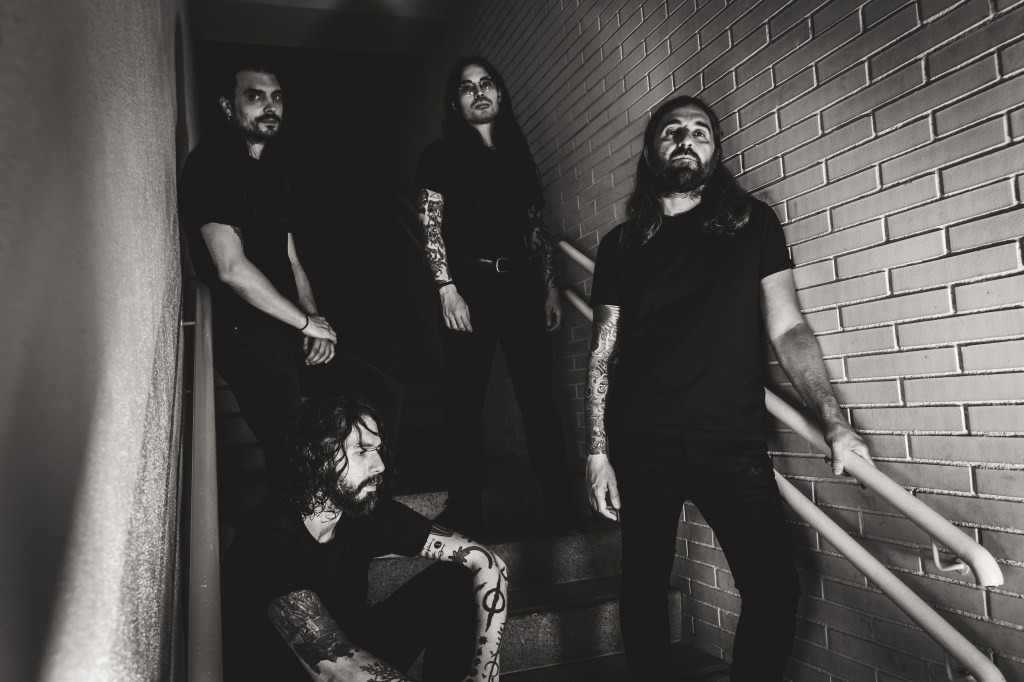
With Quan tot s’apagui, SYBERIA move deeper into that territory. The Barcelona instrumental group has long explored tension, atmosphere, and emotional weight without relying on vocals, but their newest work pushes those instincts into darker and more introspective ground. Conceived entirely in Catalan and shaped around the idea of collapse as a gradual process rather than a singular catastrophe, the album unfolds like a slow descent into stillness.
In this DeadNote Sessions interview, the band reflects on language, atmosphere, compositional patience, and the uneasy calm that arrives when resistance finally fades.
DeadNote: Quan tot s’apagui is described as your darkest and most introspective album so far. What emotional or conceptual territory were you most interested in exploring with this record?
We were interested in exploring a state of profound exhaustion, both emotional and collective. Not so much the explosion or destruction, but that moment beforehand when everything slowly begins to shut down. It’s an album that inhabits collapse understood as a process, not as a single event.
DeadNote: This is the first SYBERIA album conceived entirely in Catalan. What led to that decision, and how did working in your native language affect the creative process?
It was a very natural decision. We had never done it before, and we wondered why we continued to use English, even in an instrumental context. Catalan is our everyday language, and it seemed logical to use it for the album title and to shape the concept — not directly influencing the music, but reinforcing its identity.
DeadNote: The album frames a symbolic journey through the end of the world and the passage into nothingness. When did this idea begin to take shape?
The idea was there from very early on, even before composing. Unlike other albums, this time the concept guided the overall tone from the start. It didn’t dictate specific structures, but it did influence how the tracks were linked and how the album was conceived as a continuous journey.
DeadNote: Your music often relies on slow-building tension and carefully earned climaxes. How do you approach pacing when writing?
We don’t work with formulas. The rhythm is built quite intuitively, by listening closely to how each part breathes. When a section no longer contributes anything new emotionally, we know it’s reached its limit.
We accumulate many riffs from album to album. When the time comes, we try to assemble them to give shape to the song. Sometimes we’ve spent weeks finalizing a track by listening to it repeatedly and changing things. We don’t stop until we’re absolutely thrilled with the result.
DeadNote: Compared to Statement On Death, the new material leans further into post-metal and black metal textures. What helped guide that evolution?
It has to do with our listening habits and the band’s natural evolution. We’re particularly interested in more contemporary black metal that plays with dynamics, textures, and atmosphere. Combined with lower tunings and our drummer’s experience in that style, everything gradually evolved into a harsher, denser sound.
DeadNote: SYBERIA has always communicated powerfully without vocals. When composing, do you think in terms of narrative, atmosphere, or pure emotional flow?
We think primarily about sensations. The narrative comes later, almost as a subsequent interpretation of what’s already there. First we let the music flow and generate states of mind, then we arrange those states so they make sense within the whole of the album.
DeadNote: Titles and conceptual framing still play a large role in instrumental music. How do song titles function for you on a record so rooted in language and identity?
The titles are the final layer. They help us grasp the meaning of the album and guide the listening experience, but they never dictate the composition.
In this case, we wanted them to function almost like fragments of a poetic verse, reinforcing the sense of continuity and an implicit narrative.
DeadNote: After releasing albums with Metal Blade and now working with Moment of Collapse Records, how does this new partnership fit where SYBERIA stands artistically?
We are very grateful to all the labels we’ve worked with. We never felt any creative limitations.
Right now, working with more local and specialized labels fits well with our approach to music and with an album as introspective as this one.
DeadNote: Looking back to Drawing A Future and Resiliency, what feels most different about the band today?
The band has changed a lot since Drawing A Future and Resiliency. With the current lineup, we feel we’re at a very solid point of equilibrium. Everyone understands their role both musically and in managing the project, and that makes everything flow much more naturally.
That understanding translates directly into the music. Now we compose with more confidence, without rushing or doubt, and the result is a work in which we feel fully represented.
DeadNote: Darkness and heaviness are central to Quan tot s’apagui. Do you see any sense of catharsis within the album’s arc?
Yes, although it’s not a cathartic release. It’s more about acceptance. The album doesn’t seek redemption but rather to bear the weight of things and move through them.
In that sense, there is a kind of liberation in ceasing to resist.
DeadNote: When someone spends time with Quan tot s’apagui, what do you hope they come away carrying with them?
We hope they take away a feeling rather than a concrete idea. That the album accompanies them, unsettles them, or makes them pause for a moment. If it creates a space for reflection or silence, that’s enough.
DeadNote: Now that this chapter is complete, how do you feel it shapes the direction of SYBERIA moving forward?
We don’t see it as an end point or a manifesto. It’s just another chapter — perhaps deeper than others — but we remain open to the next album taking us somewhere different.
We’ve never planned too much for the future, and we prefer it that way.
DeadNote Sessions
Written by Rob Joncas for DeadNoteMedia.
Artist information and interview responses provided by the band.
© 2026 DeadNoteMedia. All rights reserved.
 DeadNoteMedia