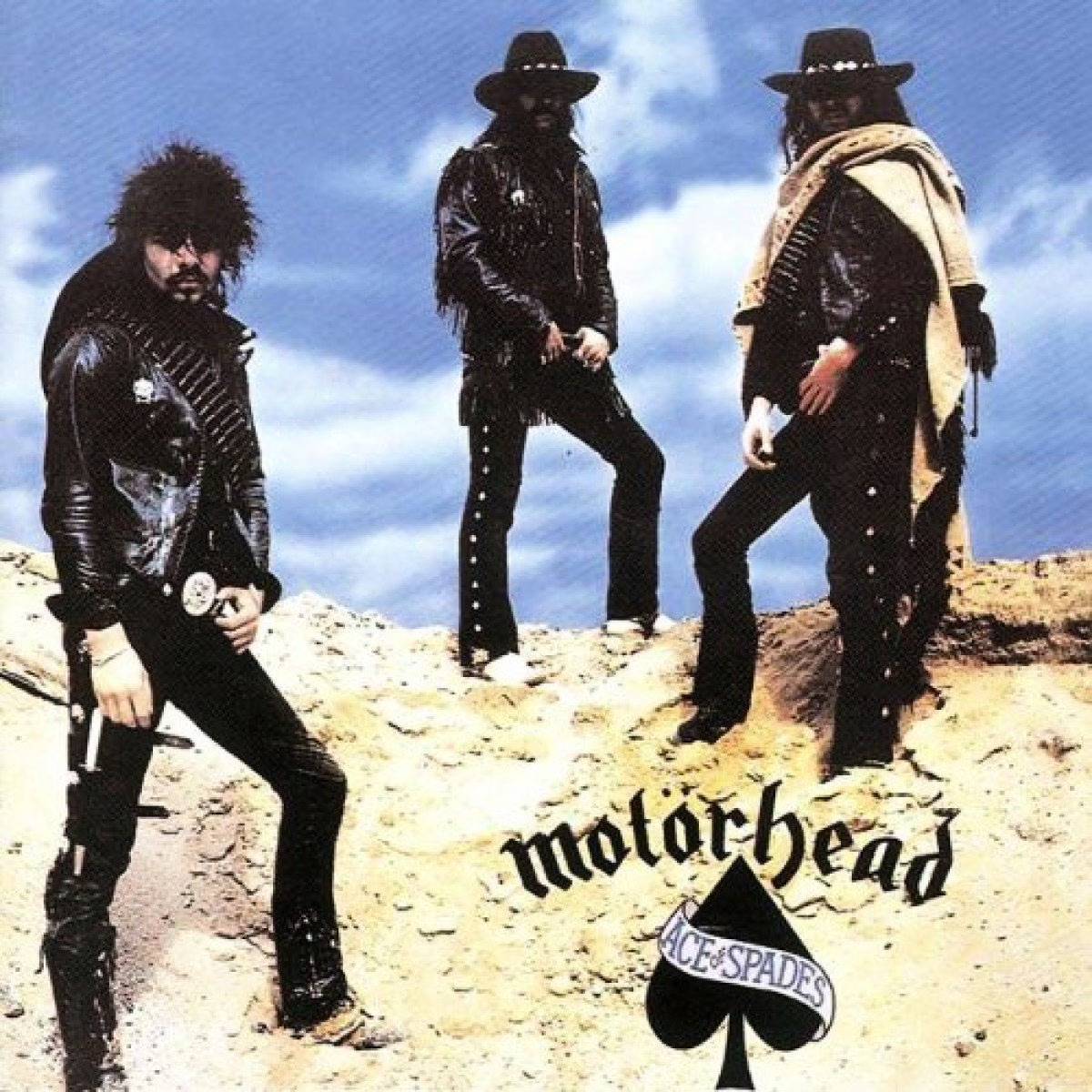
The opening bass riff of “Ace of Spades” tells you almost everything you need to know about Motörhead. Lemmy’s distorted Rickenbacker rattles away, Phil Taylor comes crashing in on the drums, and Eddie Clarke locks onto the riff with his guitar. There isn’t much room between them, and nobody seems interested in making any. Within seconds, all three musicians are going flat out, yet every instrument has a distinct part in the racket.
Released in 1980 through Bronze Records, Ace of Spades was Motörhead’s fourth studio album. The band had already established its sound on Overkill and Bomber, both released the previous year. Producer Vic Maile wasn’t working with musicians who needed a new direction. His job was capturing the force of their playing while keeping the instruments clear enough to hear what each member was doing.
Much of that comes down to the relationship between Lemmy and Clarke. Lemmy’s bass often occupies territory normally reserved for rhythm guitar, playing heavily distorted figures that give Clarke room for fills and solos. On “Love Me Like a Reptile,” their instruments grind against one another without becoming indistinguishable. Clarke’s sharp, bluesy guitar cuts through Lemmy’s dirtier tone. Neither musician sounds particularly concerned with refinement.
Taylor is just as important. His drumming on “Live to Win” keeps the song charging ahead, but the snare accents and fills prevent the rhythm from becoming a blur. He plays with a looseness that gives the music its swing, even at ridiculous speeds. Motörhead could play fast, certainly. What makes these performances interesting is how the three musicians respond to one another.
“(We Are) The Road Crew” demonstrates how much character the band could pack into a simple arrangement. The main riff is blunt, the chorus is easy to shout, and Lemmy’s lyrics deal with the considerably less glamorous side of touring. Equipment, travel, drinking, and the people keeping everything running become the subject of a hard-rock song. It’s an affectionate tribute delivered by a man who sounds as though he’s already been awake for three days.
The album’s rougher personality also comes through in “Shoot You in the Back” and “Fast and Loose.” Both draw heavily from rock and roll, particularly in Clarke’s guitar phrasing. Motörhead’s connection to punk and heavy metal often dominates discussions of the band, but the blues underneath the distortion deserves attention. Strip away some volume, and these songs have more in common with barroom rock than the increasingly elaborate metal being played elsewhere in 1980.
“The Chase Is Better Than the Catch” gives the trio room to slow down. Its swaggering guitar riff and deliberate rhythm show that Motörhead didn’t need maximum speed to sound convincing. Lemmy settles into the groove, Clarke adds some nasty guitar work, and Taylor leaves space between his accents. It’s a useful contrast to “Bite the Bullet,” which barely lasts long enough to make itself comfortable.
The record isn’t without its limitations. “Jailbait” and “Dance” stick to familiar rock-and-roll subjects, and Lemmy’s lyrical approach occasionally amounts to finding a rhyme and seeing how much trouble he can get into with it. That’s part of the band’s personality, although the music is generally more interesting than the words. The short running times help. Few songs stick around long enough to wear out their welcome.
The closing “The Hammer” returns to the frantic playing heard throughout much of the album. Taylor’s rapid drumming and the tightly locked guitar and bass give the song a punishing pace. Even here, the performance never becomes completely rigid. That slight looseness is essential to Motörhead’s sound.
Why does Ace of Spades work so well with such simple riffs, familiar subjects, and a limited musical vocabulary? Because Lemmy, Clarke, and Taylor knew how to play together. The distorted bass, cutting guitar, and unruly drumming each have a job, even when all three are competing to be heard. Vic Maile captured that relationship without cleaning up the rough edges. Twelve songs, three musicians, and very little wasted effort. Motörhead didn’t need much else.
Written by Rob Joncas for DeadNoteMedia.
© 2026 DeadNoteMedia. All rights reserved.


Leave a Reply