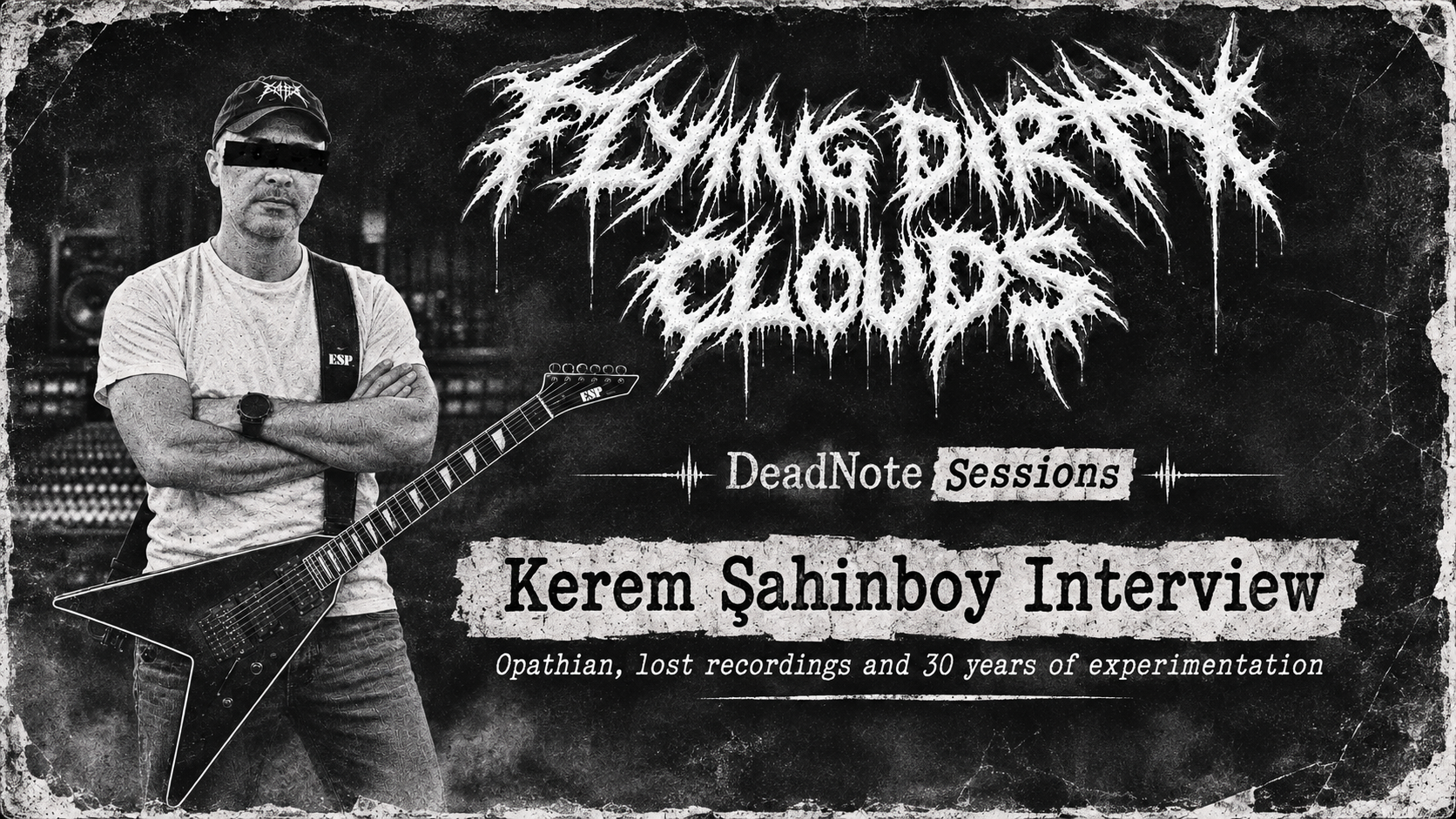
Most musicians have a pretty good idea of what they want their music to sound like. Kerem Şahinboy doesn’t seem particularly interested in setting those kinds of limits.
He’s been making music under the Flying Dirty Clouds name since the early 1990s, moving between grindcore, death metal, electronic sounds, and whatever else feels worth exploring. The musicians have changed, the recording process has evolved, and some of the band’s older material has taken an unexpectedly long road back into circulation.
His latest single, Opathian, deals with something a little more personal. It’s about the things we want out of life, the things that never happen, and how easily we can get caught up thinking about what might have been. There’s also an astronaut floating alone in space, which turns out to have a lot more meaning behind it than you might expect.
For this edition of DeadNote Sessions, Kerem talks about the story behind Opathian, growing up in Istanbul’s underground metal scene, rediscovering a recording nearly twenty years later, and why, after more than three decades, he’s still not interested in playing it safe.
DeadNote: “Opathian” explores the distance between what we desire and what we can actually reach. Where did that idea begin for you, and when did you realise it could become a song?
Kerem Şahinboy: That’s a great question to start with.
As we get older, we all find ourselves looking back more often and taking stock of our lives. Most of us have a bucket list. Beyond the things we’ve done, the things we’ve achieved and the dreams we’ve made come true, I think it’s only natural to notice how many items on that list never happened, because life never promised to give us everything we want.
Life is like a strange piece of software code made up of unrealised plans and dreams, and none of us really knows how it works. I often feel the pain of dreams I couldn’t reach, too, but that shouldn’t overshadow the beauty of being alive.
While I was composing “Opathian”, it was really important for me to realise that the main thing making me unhappy was, once again, myself. As I learned to manage my expectations, I realised that even if I couldn’t be truly happy, I was at least less unhappy.
“Opathian” tells people who are slaves to the question “What if?” that their helplessness isn’t the end. Even at the cost of being alone, we can take back control and manage our thoughts in a healthy way.
DeadNote: Flying Dirty Clouds has never been confined to one musical style. When you started writing “Opathian”, did you have a particular sound in mind, or did the music take shape as the concept developed? How different is the finished recording from what you originally imagined?
Kerem Şahinboy: Nothing changed radically from start to finish, but a song goes through its own infancy, youth and maturity. The difference between us and songs is that songs are immortal. 🙂
I’m generally not a musician who composes very quickly. I work on a riff by trying it out with different drum parts.
Even so, I love surprising everyone who listens, starting with myself. That’s how unexpected things happen, like using a transverse flute in our grindcore song “Visible Heresy”, or brass in “The King of Nothing”.
Not having a template for building a song is probably our only fixed template.
DeadNote: The astronaut in the “Opathian” video brings a visual dimension to the song’s themes of isolation and longing. How did that imagery develop, and what does the astronaut represent to you personally?
Kerem Şahinboy: Another great question.
The astronaut in “Opathian” was the only image I could find to visualise a human being at their loneliest. Alone in the middle of infinite space. Right in the middle of everything, and, at the same time, of nothing.
I identified myself with that astronaut very strongly. Then I built the storyline in my head. We generated around three hundred images and then, sticking to the storyline, turned them into five-second video clips.
By the end of the process, it felt so natural that it was as if the video hadn’t been made for the song, but the song had been written for the astronaut.
DeadNote: There’s a tension in “Opathian” between pursuing something meaningful and being consumed by that pursuit. After more than three decades of making music, has your own understanding of ambition and fulfilment changed?
Kerem Şahinboy: It definitely has. If it hadn’t, I wouldn’t be here. It has to change.
For Flying Dirty Clouds, the real motivation is change itself. For an artist, comfort means death.
I’m also really into painting, and I’ve been collecting art for about twenty years. I’m in close contact with a lot of painters, sculptors and performance artists.
I’ve watched how, once they start selling their work and their pockets fill up, they build comfort zones for themselves and then shy away from taking risks, so they don’t lose that nice income.
To me, that’s not what art should be. An artist should be reborn with every new work.
To pull that off, we have to be able to criticise ourselves harshly before anyone else does. We need to read the right things and ask the right questions.
I honestly can’t understand an artist being satisfied with what they’ve created, because whatever you make, the work is never finished. It keeps changing and growing with you.
I think that’s why no work of art should ever be seen as complete. You could say that people who are proud of their work are more craftsmen than artists.
And if we’re talking about extreme music, I think that attitude is far more extreme, unconventional, rebellious and real than the speed of a song or the harshness of the guitars.
I don’t know whether that answered your question.
DeadNote: Flying Dirty Clouds emerged in the early 1990s, when underground music depended heavily on tape trading and personal connections. What stands out most about those early years, and how did that environment shape your approach to creating music?
Kerem Şahinboy: I don’t accept the idea that music is an abstract, intangible art form.
I’m not against digitalisation. On the contrary, I’m an academic working on AI, software engineering and quantitative methods, and I believe we are wherever life has brought us.
But when music lived on tapes, vinyl and CDs, it was valued more; there was something tangible and sincere about it.
When you were trading tapes, you know how it was. Flyers would come in the envelopes, along with stickers and sometimes distro lists. Opening those envelopes and reading everything inside made me so happy.
Now we listen to music on digital platforms in a much blander way. Artists don’t get what they deserve for their work, and listeners can’t form the kind of bond they used to have with their tapes and records.
I’m still in touch with some of the friends I made back in the tape, vinyl and CD trading days. I still have an archive of photocopied-cover releases so big I can’t even guess how many there are, and they’re coming to the grave with me.
Putting a demo in the tape deck, sitting by the player and listening while reading the inlay card is like therapy.
As humanity, we’ve traded so many of our organic treasures for digital versions. Given my age, I’m one of those fans who enjoy keeping it old-school.
DeadNote: Flying Dirty Clouds has survived lineup changes and considerable musical evolution. What has allowed the project to maintain its identity through those changes, and how has your relationship with the band evolved along the way?
Kerem Şahinboy: If I’m being honest with myself, I’m not an easy person to get along with.
When I don’t get the results I expect from the team, I think I can be a bit harsh. I try to do my very best, and when other members aren’t as committed as I am, there’s no point in them being in the band anymore. New people need to step in.
In the beginning, I parted ways with the friends I founded the band with because they’d lost interest. They focused on their careers, and I can’t blame anyone for that.
It was really tough, because we don’t make commercial music. We’re not a commercial band. Flying Dirty Clouds is a very underground, experimental project.
There were times when I didn’t know who to bring in or which musicians I could work with, but after a while I solved that problem.
These days, the whole lineup changes from song to song, almost every time.
I can’t say that working with session musicians has made Flying Dirty Clouds immortal, but it has definitely extended its life a lot.
We’ve worked with some musicians on more than one song, but as I said, I believe change should be constant, so I keep working with instrumentalists who specialise in as many different genres as possible.
DeadNote: Your music has moved through grindcore, death metal, electronic experimentation, and more atmospheric territory. When you revisit your earliest recordings, what do you recognise in the musician you were then? Is there anything from those early days you consciously try to preserve?
Kerem Şahinboy: Another sharp, brilliant question.
The thing I’ve held on to most tightly from the early days is amateurism.
I’ve never seen myself as an established artist who has made it. Even though I push myself to think creatively to the point of beating myself up over it, I’m still a student just discovering my instrument.
You have to be fearless. You shouldn’t shy away from trying different formulas and experiments.
Why should a band have only one guitar tone, for example? Or does the guitar tone at the start of a song have to be the same as the one in the second half?
I’m not trying to raise a flag of rebellion against music theory, but to me, a work of art wrapped up in clichés isn’t extreme at all.
We don’t make enough use of art’s power to shock. Every shock we experience makes our neurons form new connections and helps us learn.
We need people who never stop learning. There’s no more natural goal for Flying Dirty Clouds than to confront people with experiments so different they could almost be called absurd.
Especially when we have no financial expectations. 🙂
DeadNote: The recordings for Destruction Hate Sonata were eventually recovered after a long and unusual journey. What was it like hearing that material again, and did reconnecting with that period influence how you approached the band’s future?
Kerem Şahinboy: It was unbelievable.
Even today, I can’t believe how that recording found its way back to us. Having it resurface almost twenty years after we recorded it hit us like a nuclear blast.
It was as if an invisible architect had sent us a message: “What other sign are you waiting for to carry on?”
The human brain is fascinating. The moment I listened to it again after twenty years, I travelled straight back in time. I could even smell the studio.
If we’re still going today, the Destruction Hate Sonata DAT tape turning up has a lot to do with it.
DeadNote: You’ve developed an independent approach to writing, recording, and collaborating with musicians. What has that freedom allowed you to accomplish, and which parts of working independently remain the most difficult?
Kerem Şahinboy: Convincing musicians from very different countries, with very different personalities, to go along with what I want to do isn’t easy.
With some of them, we don’t see eye to eye from the start. With others, we part ways during production.
There have even been times when a song was already finished, and I didn’t like one of the instruments and replaced it completely.
I’m in no rush, and there’s no label pushing us either. I don’t really call these difficulties. I think you have to see them as part of the nature of the work.
On the other hand, having different minds and different talents bring their own interpretation to Flying Dirty Clouds’ music has helped us grow a lot. We’ve learned really valuable things from many of them.
We’re like street dogs. You know, street dogs have the widest gene pool of all, which is why they have the strongest immune systems, so they’re the most perfect breed there is.
I think that was a pretty good analogy. 🙂
DeadNote: You’ve witnessed Istanbul’s underground metal scene change considerably since the early 1990s. What has genuinely improved for extreme metal musicians, and what obstacles continue to make sustaining a project difficult?
Kerem Şahinboy: Thirty years ago, finding a place to play wasn’t as easy as it is today. We were broke, and our gear was terrible. Even getting gig posters printed was hard work.
The scene was so small that everyone tried to support each other by buying each other’s demos. There was no internet, so we couldn’t find out right away what was happening around the world.
I remember spending my bus fare on a bootleg copy of Carcass’s first album and walking 22 kilometres home.
Now there are hundreds of bands, far more venues than before, festivals and budgets.
I’m not going to glorify the old days here. Things are much better today.
Bands can even make money, and let’s face it, that’s pretty unusual for an underground band.
DeadNote: Independent musicians can now reach international audiences more easily, but getting people to genuinely engage with the music is another matter. How do you approach promotion without allowing the demands of visibility to dictate your creative decisions?
Kerem Şahinboy: Financially speaking, I think 99% of bands are in trouble, so let’s leave the money side out of it.
When we were trading tapes, we had a very limited network. We’d write to a few trusted distros, send cash in the envelope wrapped in carbon paper (so it wouldn’t get stolen) and try to get our hands on new music.
Most of the time everything went fine, but sometimes our mail got lost or a distro turned out to be a rip-off.
Now everything is online. Nothing stands in the way of artists getting their work out to the world, but that little puddle has turned into a huge ocean.
Being visible as an artist is really hard. Either you do something truly out of the ordinary (which on its own isn’t enough), or you play a mainstream genre and throw a lot of money at it to stand out.
We have very little to do with that world. We have a small, loyal fanbase, and beyond being free enough to say what we want to say, we don’t have big expectations.
Yes, this attitude might mean bands like us are harder to hear, but it also clears away the obstacles to creating.
It’s a complicated subject.
DeadNote: More than thirty years into Flying Dirty Clouds, you’re still exploring new sounds and ideas. What remains creatively unexplored for you, and what continues to make extreme music worth pursuing after all this time?
Kerem Şahinboy: The “unknown”, and the thrill of creating without knowing what’s going to happen.
I have no idea what our next song will be like.
Actually, the song we’re working on right now is “Carrion Cloud Communion”, and yes, we know what that one will be, but whatever comes after is a complete grey area.
What we create is a reflection of what we live through. Seasons, crises, nature, political nonsense, wars, our emotional evolution, love, the values we question. Any of it could become the subject of the next Flying Dirty Clouds adventure.
We could put distortion on a church organ and sing satanic lyrics backed by a choir doing brutal vocals.
The only reason it hasn’t happened yet is that we haven’t dreamed it up. 🙂
DeadNoteMedia thanks Kerem Şahinboy of Flying Dirty Clouds for taking the time to discuss Opathian, the project’s history, and his approach to making music.

Leave a Reply