
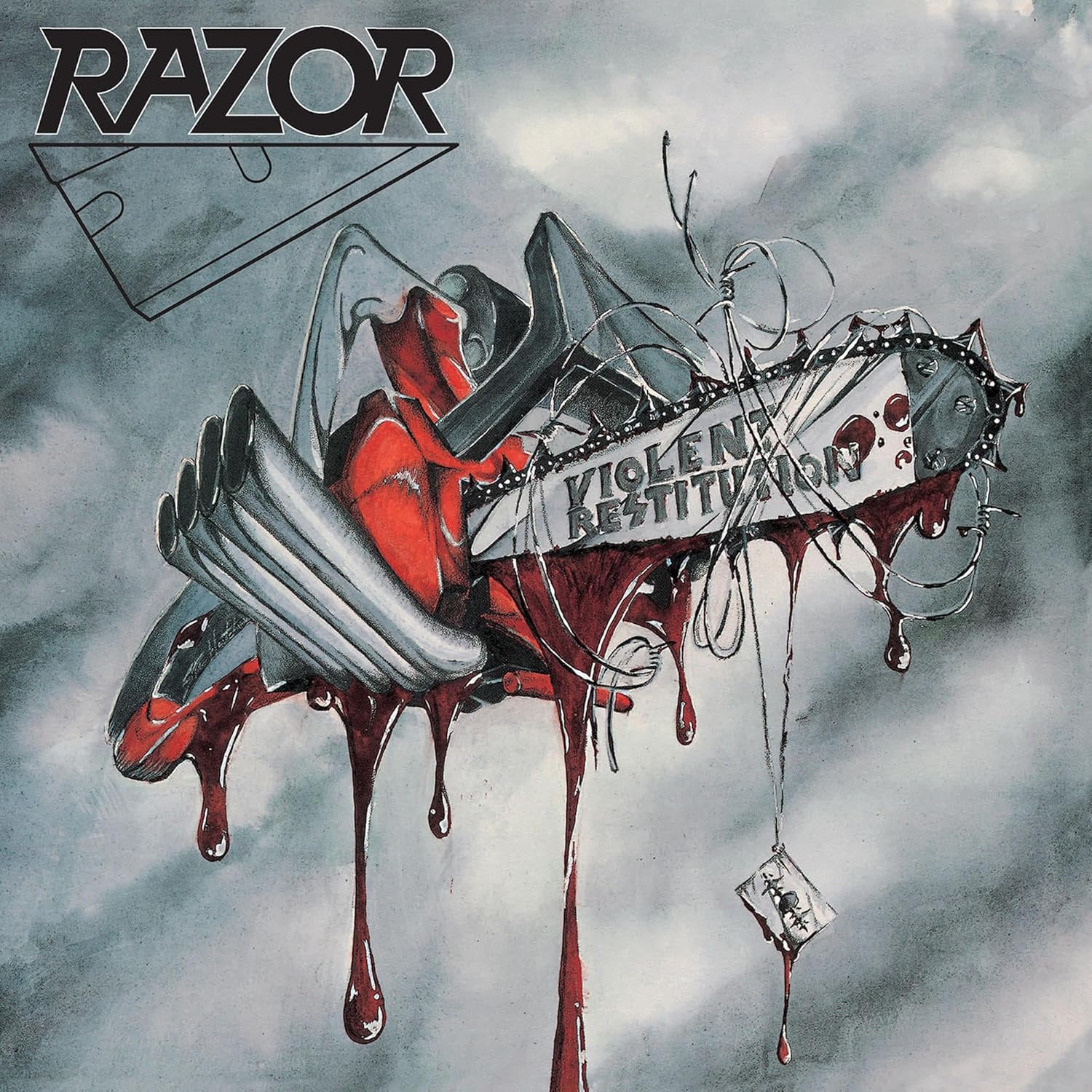
Razor dedicated Violent Restitution to actor Charles Bronson, which gives you a pretty good idea of the attitude running through the record. Across fourteen songs, the lyrics move between revenge, violence, criminal schemes, and personal grudges.
With so much anger packed into roughly forty-one minutes, how does Razor keep it from becoming one long threat?
The answer begins with Dave Carlo’s guitar playing.
“The Marshall Arts” opens with rapid guitar work, establishing the album’s pace before the instrumental leads into “Hypertension.” Rob Mills uses short fills to separate the guitar phrases and keep the changes tight.
By the time Stace “Sheepdog” McLaren’s vocals arrive, Razor has already established its aggressive approach.
Carlo later explained that he wanted to bring back the intensity he felt had been missing from Custom Killing. Although he valued that album’s more experimental material, he wasn’t satisfied with its production and wanted Razor’s next record to sound rawer and more forceful.
Recorded at Phase One Studios in Toronto between December 1987 and January 1988, Violent Restitution was produced by Brian Taylor and engineered by Bill Kennedy.
The recording gives Carlo’s guitar a sharp, abrasive attack without burying the rhythm section. Mills’ dry snare cuts through the riffs, while Adam Carlo’s bass reinforces the faster passages.
“Behind Bars” demonstrates how Razor gives familiar thrash ingredients different personalities. The guitar moves through a quick, churning riff while McLaren tells the story of a criminal who betrays his partner and escapes with the money.
“Enforcer” takes a darker approach, building around a more deliberate guitar pattern that suits its violent subject.
The title track moves quickly before breaking into a slower, palm-muted section. Carlo changes the rhythm without losing the aggression established earlier.
The differences aren’t dramatic, but they give the songs enough variety to stand apart.
Mills deserves considerable credit for making those changes work. His fills frequently arrive between guitar phrases, helping the listener follow the shifts in Carlo’s playing.
His drumming isn’t simply about keeping up with the guitar. It helps organize music that might otherwise become exhausting.
Razor also understands when to ease off the accelerator.
“Out of the Game” settles into a heavier, stomping groove, while “Edge of the Razor” begins more slowly before gathering speed.
After so many songs that attack immediately, that slower introduction makes an impression. McLaren moves between lower, rougher lines and his familiar high screams as the arrangement develops.
The lyrics provide another source of variety.
“Behind Bars” has an almost ridiculous arrogance to its criminal narrator. “Discipline” trades threats of revenge for sexual power-play imagery, while “Fed Up” abandons larger-than-life villains for something considerably more ordinary.
McLaren complains about small-city life and even mentions downtown Guelph.
It’s a wonderfully specific detail on an album filled with threats and violent characters. Suddenly, the anger isn’t coming from an imaginary criminal or a revenge-film scenario. It’s someone who’s simply had enough of the people around him.
Not everything about that confrontational attitude has aged well.
The homophobic slurs in “Taste the Floor” are an ugly reminder of how easily the album’s sneering hostility slips into prejudice. Those lyrics are difficult to defend as merely another example of Razor’s abrasive personality.
The music also has moments where its relentless pace works against it.
“Below the Belt” and “I’ll Only Say It Once” rely on similar bursts of speed and shouted choruses, making them less memorable than the stronger material.
Razor maintains its intensity throughout, but that consistency occasionally makes the songs harder to distinguish. The album’s relatively short running time helps, although it doesn’t eliminate the repetition.
Still, Violent Restitution has more musical variety than its pace initially suggests.
Carlo changes the shape of his riffs, Mills keeps the rhythm moving, and McLaren gives the lyrics different characters to inhabit. Even when the songs share a similar level of aggression, they don’t always express it in the same way.
Not every song stands out, and some of the lyrics are harder to stomach today. But there’s enough variety in Carlo’s riffs and Mills’ drumming to keep the album interesting. Razor rarely lets up, and even when the songs start sounding alike, the band still finds ways to make that aggression work.
Written by Rob Joncas for DeadNoteMedia.
© 2026 DeadNoteMedia. All rights reserved.

Leave a Reply